

I helped the tech team mature product engineering processes for a product serving 41,000+ people
Industry
SaaS and Apps
Company size
50 - 200 Employees
About
MUNIvers is a purpose-built, cloud-based software ecosystem designed specifically for local governments and municipalities. Powered by the Salesforce platform, it provides cities and civic organizations with tools to streamline revenue management (like tax and utility billing), optimise service delivery, and improve community engagement.
"The biggest shift wasn't the ceremonies. It was having someone in the room who'd seen this before and could say 'this is normal, here's how to handle it' instead of us panic-googling process solutions."

14%
Sprint velocity variance, down from over 45% pre-engagement
68%
Of the team report feeling confident in the delivery process, up from 22% in November 2024
The Situation
Agilyx builds MUNIvers — municipal software for local governments, covering council rates, utility billing, land tax, and payment processing for mid-sized councils across Australia and New Zealand. In 2024, Agilyx set out on an ambitious strategic move: rebuilding MUNIvers on Salesforce to move faster and tap into a much larger platform ecosystem.
It was a genuinely ambitious undertaking — a fast-growing Salesforce skillset, a hard deadline for a major client’s proof of concept, full deployment soon after, and a legacy application that needed to be decommissioned on a fixed date. Agilyx brought in Halcrow to help build the process maturity needed to deliver all of it with confidence.
The Key Result Metric:
Build a delivery process mature enough to hit aggressive deadlines with confidence, while the team continued growing its Salesforce capability.
Why they called us
Agilyx called Halcrow because they wanted a partner who’d been through exactly this kind of transition before — a fast-moving platform migration paired with real client deadlines. Jack Murray and Agilyx’s leadership wanted someone who could operate at the team-structure layer, not just the code layer, to complement the deep Salesforce and product expertise already growing inside the business.
Agilyx’s ambition was clear from day one: embed a Scrum Master and product management function that could reconcile client commitments with the realities of building on a new platform, taught hands-on rather than delivered as a report.
How we worked
Two Embedded Roles, Working as Co-Pilots
Halcrow embedded two roles directly alongside Agilyx’s own team from day one.
Scrum Master Embedding
A dedicated Scrum Master joined every ceremony — daily standups, sprint planning, retrospectives, and backlog refinement — running scrum alongside the team until it became second nature.
Product Manager Embedding
A Product Manager worked directly between the founder’s vision and the dev team, translating business needs into clear user stories, prioritising the backlog, and creating a “Ways of Working” guide the whole team could rely on.
Build Structure: Establish the System, Then Transfer It
Phase 1: Process Foundation (November–December 2024)
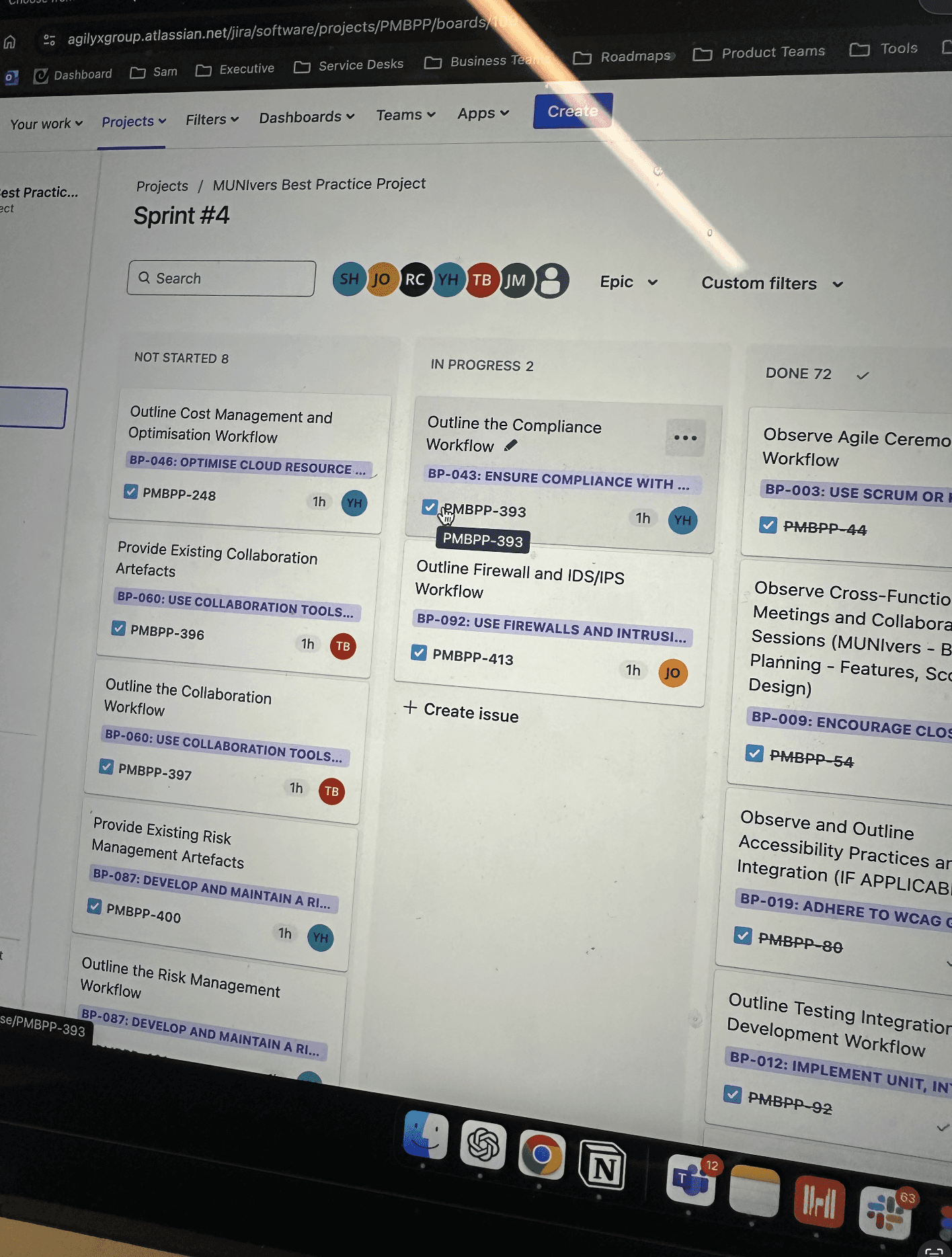
The team began running full scrum ceremonies from week one — daily standups, sprint planning, retrospectives — building real momentum quickly. Alongside this, the team documented a Ways of Working guide and ran an 83-point best-practice assessment to map exactly where to focus.
Capability Transfer Is the Real Deliverable
Every ceremony was documented as it ran, so Agilyx could keep running it long after the engagement wound down.
Phase 2: Client Deadline Sprint (January–June 2025)
Sprint planning locked in scope, daily standups surfaced blockers same-day, and retrospectives caught process improvements early. When the major client asked for a significant feature addition six weeks before deployment, the Product Manager gave the client a clear, confident choice between two strong options. The client chose to defer, and the feature shipped two months later, on time and properly tested.
Adaptive Replanning Beats Rigid Commitment
Treating commitments as constraints to optimise around, rather than fixed promises, kept the whole team’s stress profile healthy and sustainable.
Phase 3: Capability Transfer (mid 2025–November 2026)
The Scrum Master’s role faded naturally as the team internalised the rituals — developers began running their own standups, and a newly hired Product Owner took over backlog management. By November 2026, Agilyx had eighteen months of strong ceremony muscle memory and a fully self-sufficient delivery process.
WHAT CHANGED
Velocity
Sprint velocity variance landed at 14%, with story completion rate reaching 87%. Mid-sprint scope changes affect fewer than 5% of sprints, and blockers now resolve in about 1.2 days on average.
Team Health
68% of the team report confidence in the delivery process, 71% know what to do when stuck, and 54% describe their stress as manageable — each a strong, healthy result for a team mid-transition onto a new platform.
Client Delivery
The major client deployment landed on time. The feature deferral was negotiated successfully, leaving the client satisfied with the phased approach. The legacy application was decommissioned exactly on schedule.
Then:
“We’re building fast and learning a new platform at the same time — we need a process that can keep up.”Now:
“We know our velocity. We know what we can commit to. When clients ask for more, we can show them the trade-offs and let them decide.”
WHY THIS WORKED
Why the embedded model worked for Agilyx
Most "agile transformation" projects fail because they treat process adoption as a training problem: send people to a certification course, hand them the Scrum Guide, hope they figure it out. Agilyx worked because we treated it as an embedding problem instead. You don't learn to run scrum by reading about it. You learn by doing it alongside someone who's done it before, until doing it feels normal.
Structural Distance Creates Friction
The Scrum Master wasn't a coach who showed up once a week. They were in the daily standups, the sprint planning, the retrospectives. When something felt off (stories not getting refined before planning, for example) they caught it in real time, not in a quarterly review.
Decision Latency Compounds Into Dysfunction
The Product Manager sat directly between client commitments and development capacity. When scope changes came in mid-sprint, decisions happened the same day: "we can do this, but it pushes something else to next sprint, or we defer it — your call." The old model left decisions queuing for days while everyone tried to work out the impact themselves.
Capability Transfer Is the Exit Strategy
We didn't sell a long-term retainer. We sold "we'll run this with you until you can run it yourselves." By month eighteen, Agilyx was operating independently, the engagement ended on schedule, and that was the goal from day one.
what you’re buying
If your team is scaling fast and adopting a new platform under real deadline pressure, this is what an embedded, hands-on partner who has done this before looks like. You’re not buying our time — you’re buying a structured ramp to operational autonomy.
Ready to build that kind of momentum? Contact Sam Halcrow on 0431197004 or sam@halcrow.com.au.