
I led the technical build of purpose-built software powering a new EV parking network across NSW
Industry
Manufacturing
Company size
50 - 200 Employees
About
Bovara is a leading Australian-owned manufacturer and designer of electrical equipment, switchboards, and enclosures. Operating for over 30 years with headquarters in Sydney and facilities in Victoria, they serve the commercial, industrial, and renewable energy sectors.
"The reason this worked is Halcrow didn't try to build everything custom. They found the right balance: proven open-source for the hard infrastructure problems, custom development for the consumer experience. That's what got us to market in 5 months instead of 18."

30 locations
Charging stations deployed within business parks across Sydney, Melbourne, and Brisbane
4 weeks
Hardware validation time vs. 3-6 months if Bovara had sourced independently
The Situation
Bovara, a long-established Australian electrical manufacturer, identified a major opportunity in Australia’s growing EV charging infrastructure market. With EV adoption accelerating and government incentives flowing, Bovara set out to build a complete charging platform — physical stations paired with a consumer-facing mobile app — entering the market as a genuine integrated services provider rather than purely a hardware distributor.
Bovara brought deep hardware and manufacturing expertise to the table. To bring the software side of the vision to life on an ambitious timeline, they partnered with Halcrow.
The Key Result Metric:
Launch a working EV charging platform within six months, with a charging session reliability rate above 95% and real-time progress tracking drivers could fully rely on.
Why they called us
Bovara could have gone to a traditional software agency and asked for an EV charging app built from scratch. Most would have quoted twelve to eighteen months and started designing from first principles. That timeline simply didn't work against a five-to-six-month deadline.
Bovara called Halcrow because they'd already watched competitors struggle with the same problem, and concluded that the fastest path to launch isn't building everything custom. It's knowing precisely what to build custom and what to borrow from infrastructure that already exists and already works.
The brief, in practice, had three parts:
Solve the hardware supply problem by finding compliant charging station controllers that could be sourced reliably and at scale;
Accelerate software development by using proven existing foundations for the hard infrastructure problems and reserving custom development for the consumer-facing layer;
Fix the notification dependency, since real-time charging updates breaking the moment a user disabled notifications was a structural design flaw, not a minor feature gap.
Halcrow had also worked with Bovara before on adjacent hardware-software projects, so they already knew we understood the difference between building a fully custom system (slow, expensive, high risk) and assembling a platform from proven components with custom work layered on top only where it actually mattered for the user.
How we worked
One team with a range of capabilities, embedded directly
Halcrow provided a cross-functional team embedded directly inside Bovara's product development:
1 hardware sourcing specialist for supply chain and compatibility
2 backend engineers for the charging management system, payments, and session handling
2 mobile developers covering iOS and Android natively
1 DevOps engineer for cloud infrastructure and real-time data monitoring.
Direct access to hardware suppliers and Bovara’s own cloud and payment infrastructure meant the team could move at the speed the opportunity demanded.
Build structure: layered development on proven foundations
Phase 1: Hardware Foundation (Month 1)
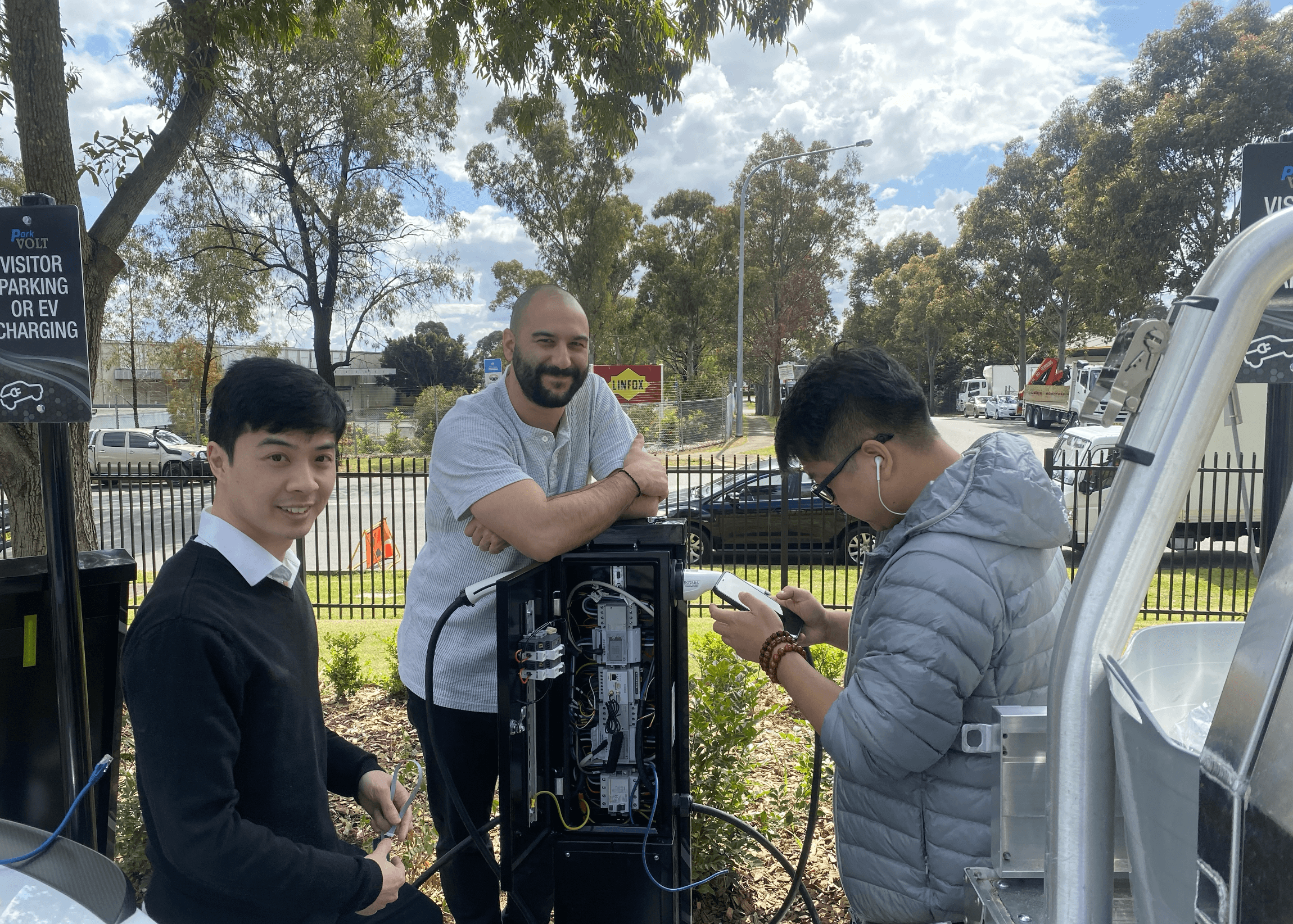
We used existing supplier relationships to secure a manufacturer with strong protocol compliance and a proven local track record, locking in a supplier agreement within weeks and validating a first batch of controllers before scaling further.
Phase 2: Software Foundation (Months 2–3)
Rather than reinventing solved infrastructure, we built on proven open-source foundations for charging session management and focused our custom development where it mattered most: user authentication, payments, and the mobile experience. This decision alone saved at least two months of development time.
Solved Problems Don’t Need Custom Solutions
Using proven infrastructure for the hard problems freed up the team to focus custom development exactly where Bovara could differentiate: the driver experience.
Phase 3: Mobile App Development (Months 2–4)
Beta testing surfaced a valuable early insight around notification settings, and the team responded quickly with a real-time streaming solution — ensuring every driver sees reliable charging progress, however they’ve configured their phone.
Phase 4: Pilot Deployment (Month 5)
Ten stations launched first across shopping centres, workplaces, and apartment complexes, generating fast, valuable feedback that shaped the platform before the wider rollout.
Phase 5: Public Launch (November 2023)
The platform expanded confidently from 10 pilot stations to more than 30 across Sydney, Melbourne, and Brisbane.
WHAT CHANGED
Platform Performance
By the end of the year, Bovara was running 30 charging locations across three cities, with more than 850 app downloads and over 320 completed sessions in the first 30 days. Session success rate reached 97%, ahead of the 95% target.
Development Speed
The platform launched in just 5 months, a fraction of the typical 12-to-18-month timeline for a fully custom build — a genuine first-mover advantage in a fast-growing market.
Driver Experience
Charging progress updates are 100% reliable regardless of notification settings, and session start latency sits comfortably under 3 seconds.
Then:
“We see the opportunity in EV charging and we’re ready to build something genuinely great.”Now:
“We’re live with 30 stations. The platform works. Drivers are using it. We can scale this nationally without rebuilding the core infrastructure.”
WHY THIS WORKED
Build Where It Matters Most
Proven infrastructure handled the hard, solved problems, freeing the team to put real energy into the experience drivers actually feel — the part where Bovara could genuinely stand out.
Validate, Then Scale
A small first hardware batch and a focused 10-station pilot built real confidence before the wider rollout, letting the team scale with genuine certainty.
Question Assumptions to Find the Best Solution
Looking past the standard approach to push notifications led directly to a more robust, more reliable charging experience for every driver.
what you’re buying
If you’re entering a new market on an ambitious timeline, this is what it looks like to combine proven infrastructure with focused custom development — and move fast without cutting corners.
Ready to compress your own time-to-market? Contact Sam Halcrow on 0431197004 or sam@halcrow.com.au.